
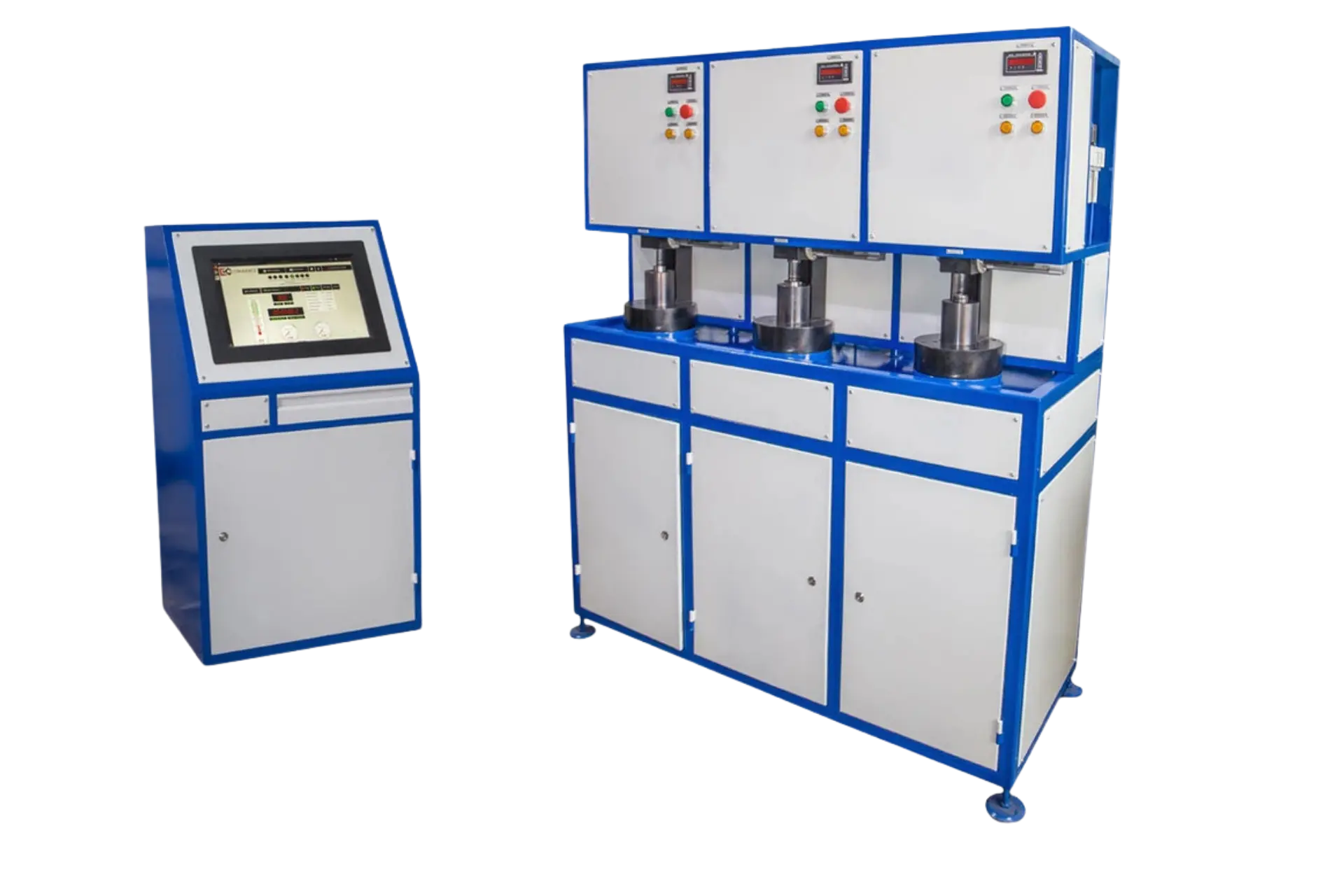
The Vacuum Test Bench by Ecotech Industries is a precision-engineered solution designed to perform leak testing and vacuum performance validation on a wide range of industrial components. Built with advanced controls, stainless steel construction, and automation-ready features, this test bench ensures accurate, repeatable results while meeting global quality and safety standards.
Vacuum testing is critical in industries like automotive, aerospace, energy, and manufacturing, where even the smallest leaks can cause major failures. Ecotech’s vacuum test bench is designed for durability, operator safety, and long-term reliability in demanding environments.
The bench is capable of generating and maintaining vacuum levels suitable for testing a variety of industrial components. This ensures flexibility in both low and high vacuum applications.
The entire body, chamber, and piping are constructed using SS 304 stainless steel for durability, corrosion resistance, and hygienic operation. The rugged construction guarantees long service life under continuous industrial use.
The vacuum test bench integrates PLC control with touchscreen HMI, providing real-time monitoring, automatic cycle management, and easy data handling. Operators can run tests in both automatic and manual modes, depending on the requirement.
Fitted with high-accuracy vacuum transmitters and sensors, the machine provides precise measurement of leaks and vacuum pressure levels, ensuring components meet strict performance criteria.
Each test cycle is automatically logged, with results stored in Excel format for traceability. Graphical representation of test data allows operators to analyze results quickly and make informed decisions.
The test bench can be designed with customized fixtures to handle different part sizes and geometries, ensuring flexibility for industries with diverse product lines.
Operator safety is built into the system with polycarbonate transparent doors, safety interlocks, and over-pressure/over-vacuum protection systems. These features ensure safe operation during every test cycle.
The Vacuum Test Bench is widely used across industries for:
Automotive – Testing fuel tanks, brake components, and vacuum-based systems.
Aerospace – Validating vacuum performance of aircraft hydraulic and pneumatic parts.
Manufacturing – Leak detection for plastic, metal, and composite parts.
Energy Sector – Testing pipelines, valves, and energy storage components requiring vacuum conditions.
Research & Development – Laboratories and institutes use it for controlled vacuum experiments.
Accurate Leak Detection – Identifies even micro-leaks under vacuum conditions.
Durable Design – Stainless steel build ensures resistance against wear and corrosion.
Traceable Results – Data logging and graphical representation improve documentation and compliance.
Operator-Friendly – PLC touchscreen control makes operation simple and reliable.
Customizable – Designed to suit different components, industries, and standards.
Safe & Reliable – Integrated safety features protect both operators and test samples.
Ecotech Industries has decades of experience in designing testing and automation systems that meet the most demanding industrial requirements. Our vacuum test bench combines high-quality materials, advanced automation, and strong safety measures, making it a trusted solution for manufacturers worldwide.
With proven expertise in leak testing, durability testing, and industrial automation, Ecotech ensures that each vacuum test bench is built to deliver reliability, compliance, and long service life.
Have specific standards, pressure/temperature ranges, or cycle‑life targets to hit? Share the application details—media type, test envelopes, fixture needs, and documentation requirements—and a tailored Special Purpose Machine will be engineered with PLC/HMI control, SS 304 construction, and audit‑ready data logging for fast approvals. From concept and FAT to on‑site commissioning and training, the team partners end‑to‑end to deliver safe, repeatable performance that accelerates validation and production throughput.
Collaborate on application requirements, standards (SAE/ISO/custom), target pressures/temperatures, cleanliness (NAS), cycle time, and safety to lock specifications and acceptance criteria.
Engineer the machine with SS 304 hardware, servo motion, PLC/HMI, sensors, and fixturing; develop programmable recipes, barcode/traceability, and data logging with graphical results.
Run FAT with calibrated media and profiles, ship and commission on site, train operators, and provide ongoing service, spares, and performance optimization.